Why are some people naturally more motivated to exercise?
Because their brains, trauma history, and personality quirks came together like a Marvel origin story — only instead of superpowers, they got a love for spin class.
TL;DR
- Biology plays a big role: Higher baseline dopamine sensitivity can make exercise feel more rewarding for some people.
- They’ve formed better habits: Often, people who love exercise started young or made it part of their identity.
- It serves an emotional purpose: For some, movement is a key part of their anxiety management and self-regulation tools.
- Trauma responses vary: While some dissociate and freeze, others deal with stress by burning it off — literally.
- You’re not broken: Motivation is not a moral trait — it’s a fluctuating state shaped by your nervous system, circumstances, and (yes) late-stage capitalism.
Understanding Mental Health Burnout and Exercise Resistance
If you’re reading this, you probably haven’t done a cartwheel since sixth grade gym class — emotionally or physically. And yet, you’re constantly told that moving your body will somehow fix your spiraling thoughts, cortisol-drenched circuits, and the deep-seated ache of simply being alive. Cute advice. Almost offensive.
Mental health burnout creates a unique relationship with movement. When you’re operating on emotional fumes, exercise can feel like another demand rather than relief. But here’s what naturally motivated people discovered: somewhere along the line, moving started feeling like relief, not punishment. That moment? That’s what we’re going to dissect (and gently chase) today.
Coping Strategies for the Overwhelmed Creative

If your brain feels like a browser with 47 tabs open — and one is playing music you can’t find — welcome. You’re probably juggling an existential crisis, two deadlines, and a vague ache behind your left eye. This mental health burnout is real, and it affects how we approach self-care tips and movement.
Here’s the thing: Motivation isn’t a magical feeling. It’s the byproduct of action. For burned-out creatives especially, moving your body isn’t about sculpted abs or a FitTok transformation — it’s about disrupting the loop of thought that won’t shut up.
Effective coping strategies include:
- Somatic movement: Go for awkward dancing in your messy bedroom. Your nervous system doesn’t care how you look; it cares how you feel.
- Creative embodiment: Paint on your arms with cold water while walking. Yes, that sounds unhinged. It’s also grounding.
- 5-minute pledges: Move for 5 mins, not 45. Set the bar so low you can’t trip over it. You’ll trick your brain into starting.
The goal isn’t to become a morning-run person. It’s to move like your life depends on it — because emotionally, it might.
Anxiety Management: Finding Peace in Chaos
Ever feel like your brain is operating on 17 inner monologues, 3 existential questions, and the soundtrack to a funeral you haven’t planned yet? Yeah. That’s not ideal for exercise motivation.
But for people who are naturally drawn to exercise, movement often serves as a reset button for anxiety management. It’s their coping strategy, their meditation, their version of turning the computer off and on again. When mental health burnout meets anxiety, traditional approaches often fall short.
Ways to develop anxiety management through movement:
- Create motion-based rituals before emotional spirals begin (e.g., pace while on the phone, stretch while stressing).
- Try rhythmic movements: walking, swimming, even marching in place helps regulate a dysregulated system.
- Nervous system-friendly exercises like tai chi, restorative yoga, and primal movement are built for our flavor of anxious.
Your body holds the trauma, but it also holds the release. No pressure. Just something to remember the next time you can’t breathe for no reason.
Self-Care Tips for When Everything Feels Like Too Much
Let’s be honest: when the world is burning (literally/mid-metaphorically), putting on matching socks feels like a triumph. So how the hell are we supposed to stretch, hydrate, and move joyfully? These self-care tips acknowledge the reality of mental health burnout.
Answer: You aren’t. You’re supposed to fake it in a way that eventually makes it feel safe. Here’s what I mean.
- Use object permanence: Leave a foam roller or mat out as a visual cue. Your future self will be annoyed, but grateful.
- Link it to stimulation: Move while watching a trashy TV show. That’s not failure — that’s survival-tier multitasking.
- Redefine success: Doing 3 squats on the way to the fridge is movement. Celebrate it. Give it a parade.
Self-care tips aren’t bubble baths and affirmations when you’re fried. It’s tricking your brain into feeling aliveness without the threat of productivity.
Mindfulness Practices to Quiet the Noise
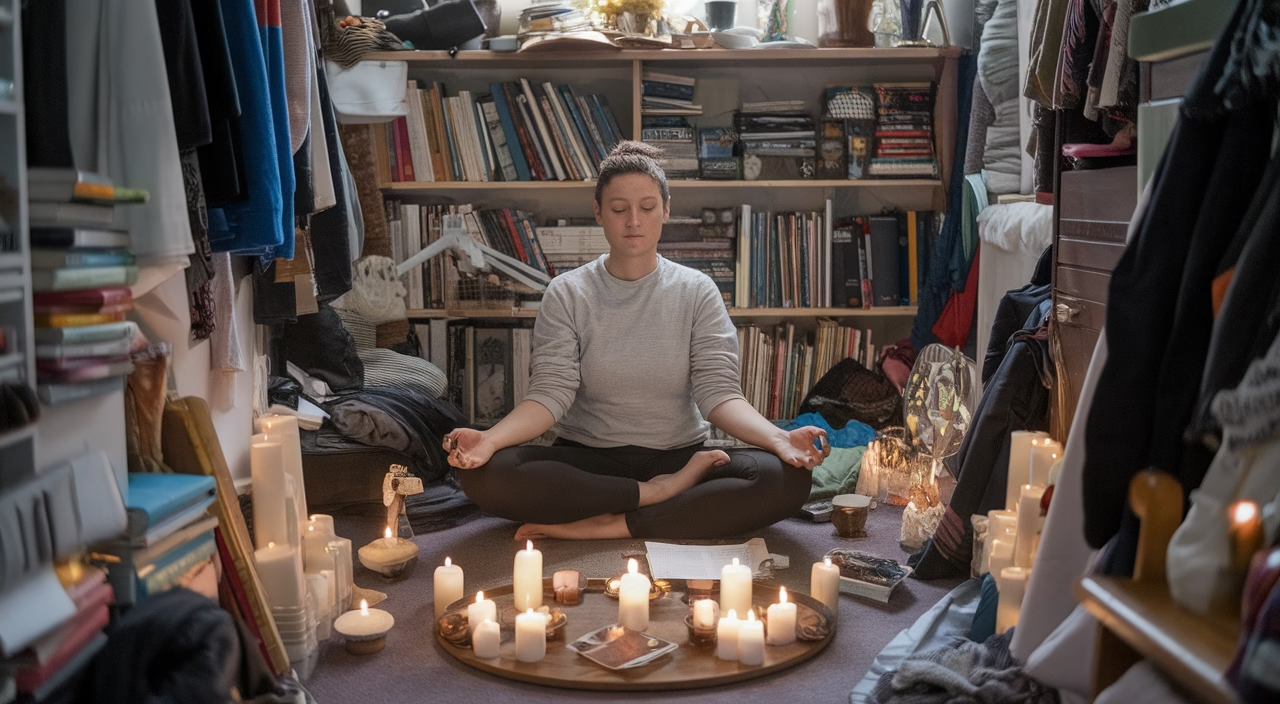
Some people meditate in silent rooms with handmade stools and flickering candles. You, meanwhile, accidentally meditate when you zone out staring at the microwave. These mindfulness practices work even during mental health burnout.
Mindfulness doesn’t have to look good. It just has to ground you.
Try micro-practices that double as coping strategies:
- 5-5-5 breath: Inhale 5, hold 5, exhale 5. Repeat until the noise dips below DEFCON 1.
- Body scanning: Ask each part of you what it’s holding emotionally. Yes, including the buttcheeks.
- Walk-to-feel: Take a walk specifically to feel your feet. Don’t track it. Don’t post it. Just walk to be human.
Mindfulness practices help us reconnect to our bodies, which — bad news — is often the last place we want to be during mental health burnout. But also where healing lives.
Stress Relief Techniques for the Emotionally Fried
If you’ve been coasting on cortisol like it’s Red Bull, congrats — you’re officially qualified in the field of “unregulated stress junkie.” These stress relief techniques acknowledge that traditional anxiety management often misses the mark.
Natural exercisers often use movement to complete their stress cycles. Mental health burnout builds when those cycles don’t close. Here’s how to gather your emotional leftovers and give them somewhere to go:
- Shake. Literally. Think dog-after-bath level nervous system reset.
- Breath+movement combos: Jumping, stomping, dancing while exhaling like you mean it.
- Move with purpose: Scrub your tiles with rage. Vacuum with vengeance. You’re not doing chores — you’re processing grief.
Stress doesn’t magically leave your body. It moves — or it hardens. Let’s choose movement, even badly done. These stress relief techniques become essential coping strategies when everything else feels overwhelming.
Final Thought
You don’t need to become a person who loves exercise. You just need moments of movement that feel less like punishment and more like coming home to yourself. Some people got there faster. But that doesn’t mean you can’t find your version of peace through movement — even if it starts with a slow, accidental stretch between doomscrolls. Mental health burnout doesn’t have to be permanent, and these self-care tips can help you find your way back to yourself.
FAQ
- Why do I feel worse after exercise instead of better?
Some people with trauma or high anxiety may find intense exercise dysregulating. Try slower, sensory-based movement first. - How do I get motivated to move when I’m mentally exhausted?
Tiny steps. Think 30 seconds. Movement isn’t a celebration of wellness — sometimes, it’s the first sign of life returning. - What if I just hate exercise?
Cool. You don’t have to love it. Just find movement that doesn’t feel like betrayal. Walking, shaking, pacing — it all counts. - Are there exercises specifically good for burnout?
Yes: restorative yoga, tai chi, slow walking, qigong, and trauma-sensitive somatic workouts are all burnout-friendly. - Can movement really help anxiety management long-term?
Yes, but it’s not a replacement for therapy. Think of it as an anchor, not a cure-all. Consistency matters more than intensity. - How do I stop overthinking and start moving?
Focus on action, not the outcome. Trick your brain into taking the first small step — the rest will follow.