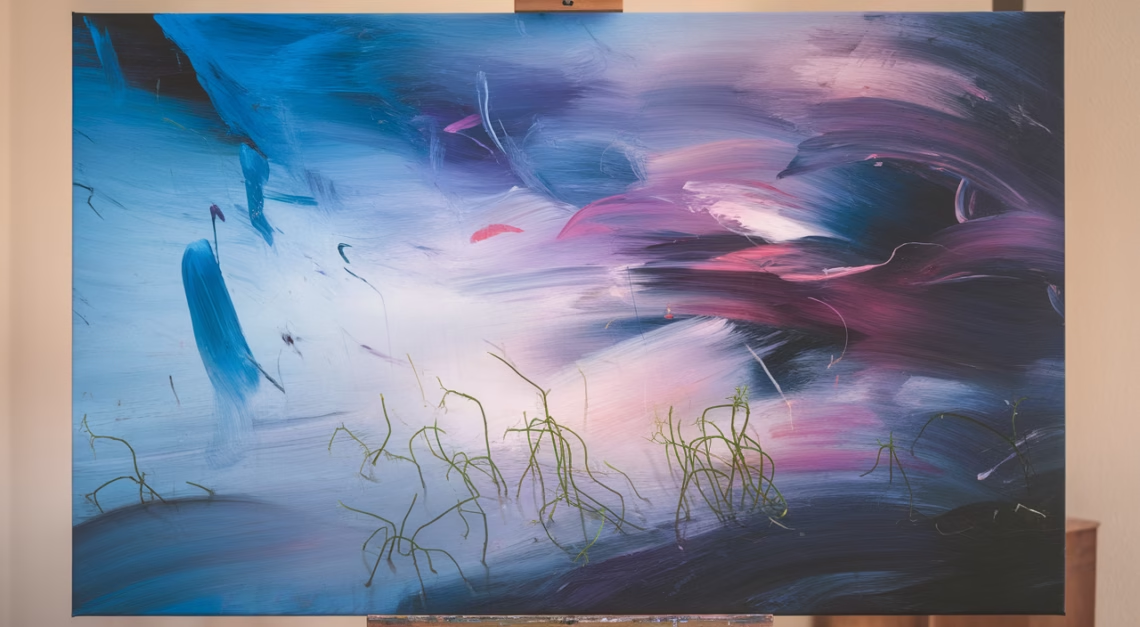
Laughing Through the Chaos: A Burnt-Out Creative’s Guide to Surviving Overthinking and Anxiety
You acknowledge the absurdity of it all, that’s how. Burnout isn’t a gentle whisper; it’s a full-blown scream from your soul, leaving you feeling like a soggy teabag after a particularly rough week. But what if, instead of just drowning in the despair, we learned to float—or at least flail a bit—with a dark chuckle?
TL;DR
Look, I get it. Your attention span is probably as fried as your nervous system. So, here’s the lowdown on how to survive burnout with a sense of humor, because frankly, what’s the alternative? More crying? Been there, done that, got the stained pajamas.
- Embrace the Glorious Mess: Forget perfection. It’s a myth. Your life is a chaotic masterpiece of half-finished projects and existential dread. That’s okay. Truly
embracing imperfection
is your first step to sanity. - Your Brain, The Overthinking Machine: Acknowledge that your mind is a relentless, noisy beast. Don’t fight it head-on; learn to observe its antics. This is the foundation of
self-care for overthinkers
. - Laugh Until It Hurts (Then Laugh Some More): Dark humor isn’t just a coping mechanism; it’s a survival tool. Turning your misery into a punchline is a surprisingly effective way of
overcoming overthinking with dark humor
andcoping with anxiety
. - Vulnerability Isn’t a Weakness, It’s a Flex: Seriously, drop the mask. Nobody’s got it all together. When you start
embracing vulnerability
, you realize everyone else is just as terrified, which is oddly comforting. - Hope is a Tiny, Stubborn Weed: It doesn’t need grand gestures. Sometimes,
finding hope in chaos
means acknowledging you survived another Tuesday. Celebrate that win. - Redefine Self-Care: It’s not just bubble baths; it’s setting boundaries, saying no, and occasionally locking yourself in a room with a blanket fort. This is practical
self-care for overthinkers
in action. - You’re Not Alone: This isn’t a solo journey. Many of us are
surviving burnout
one cynical joke at a time. The shared struggle is where real connection happens.
Embracing Imperfection: Coping with Anxiety in a World of Overthinkers
Alright, fellow creative zombies, let’s talk about the monster under the bed: perfectionism. It’s not just a flaw; it’s a deeply ingrained societal expectation, especially for those of us who make a living (or try to) by putting our souls on display. The pressure to be ‘on,’ to be original, to be flawless, to churn out brilliance at breakneck speed, it’s enough to make anyone want to curl up into a fetal position with a year’s supply of instant noodles. Here’s what often happens: you start a project, brimming with passion, only for your inner critic—who sounds suspiciously like your least favorite high school teacher—to pipe up. ‘Is it good enough? Is it unique? What will *they* think?’ And just like that, the joy curdles into a nauseating stew of doubt. This constant internal battle is exhausting, and it’s a huge component of what makes coping with anxiety
such a Herculean task when you’re already feeling the crushing weight of surviving burnout
.
The Relentless Loop: When Your Brain Just Won’t Quit
Ah, the sweet symphony of an overthinker’s mind. It’s not a gentle murmur; it’s a full-blown orchestra playing a frantic, repetitive score of ‘what ifs,’ ‘should haves,’ and ‘oh my gods, did I send that email with a typo?’ For burnt-out creatives, this loop isn’t just background noise; it’s the primary soundtrack to our lives, drowning out any semblance of peace. You finish a creative endeavor, or even just a mundane task, and instead of a quiet sense of accomplishment, your brain immediately launches into a post-mortem analysis. Every decision is second-guessed, every word replayed, every interaction dissected. It’s like having a tiny, incredibly judgmental auditor living rent-free in your skull, demanding a full report on every single thought and action. In practice, you’ll notice this manifesting as paralysis. You want to start a new project, but the sheer volume of potential missteps your brain can conjure up stops you dead in your tracks. You want to relax, but your mind is already planning tomorrow’s disasters. This isn’t just annoying; it’s a significant barrier to effective self-care for overthinkers
. Because how do you care for a mind that refuses to shut up and just *be*?
The insidious thing about this relentless loop is that it often masquerades as being productive or responsible. We tell ourselves we’re just being thorough, being careful, planning ahead. But there’s a fine line between thoughtful consideration and spiraling into an abyss of hypothetical scenarios. The exhaustion from this mental acrobatics contributes directly to the feeling of being utterly depleted. It’s not just physical fatigue; it’s a deep, soul-crushing weariness from constant internal vigilance. And when you’re already trying to figure out how to survive burnout with a sense of humor
, that internal critic just becomes another voice you want to mute. But muting isn’t the answer. Learning to observe, to acknowledge, and sometimes, to laugh at the sheer absurdity of your brain’s antics, that’s where the real shift begins. It’s about recognizing that your thoughts are not always facts, and your worst-case scenarios are often just fiction written by an overly stressed scriptwriter in your head.

Permission to Be Messy: Defying the Cult of Perfection
Let’s be honest. The idea of embracing imperfection
sounds lovely on a motivational poster, but in reality, it feels like giving up. Especially for creatives. We’re wired to strive for beauty, impact, and a certain je ne sais quoi that makes our work, well, *ours*. But what happens when the pursuit of perfection becomes a gilded cage, trapping you in an endless cycle of self-criticism and unfinished projects? You know the feeling. You slave over a piece, convinced it’s not quite right, delete it, start again, only to repeat the cycle. Or worse, you never start at all, because the imagined perfect outcome feels too far out of reach. This isn’t just about art; it’s about life. The perfect morning routine, the perfect diet, the perfect social media presence. It’s all a meticulously curated lie that none of us can truly sustain.
Here’s the brutal truth: nobody cares as much as you do. And if they do, their opinion probably stems from their own insecurities. Your mess, your quirks, your beautifully imperfect existence—that’s what makes you interesting. That’s what makes your art, your work, your *you* authentic. In practice, embracing imperfection
means consciously choosing to release the chokehold of unrealistic standards. It means submitting that draft that isn’t quite polished but conveys the message. It means letting your house be a little lived-in. It means allowing yourself to make mistakes and, gasp, *learn from them* without spiraling into a shame spiral. For self-care for overthinkers
, this is absolutely vital. You cannot truly rest or recover if your mind is constantly fixated on the gap between reality and some flawless ideal. Giving yourself permission to be messy is giving yourself permission to be human, to be real, and most importantly, to be free from the constant judgment of that internal critic. It’s the messy, unpolished bits that connect us, that make us relatable. And in the journey of surviving burnout
, that connection is everything. It allows us to release the need to appear perfect, and instead, just *be*.
Finding Humor in Chaos: Surviving Burnout with Self-Deprecating Wit
If you’re anything like me, your primary coping mechanism for any minor inconvenience—or existential crisis—is to immediately turn it into a darkly funny anecdote. Because what else are you going to do? Cry? Been there, done that, the tear stains on my keyboard are a testament to my dedication. How to survive burnout with a sense of humor
isn’t just a catchy phrase; it’s a legitimate survival strategy when your world feels like it’s perpetually on fire and you’re out of marshmallows. Generic positive affirmations often feel like a slap in the face when you’re waist-deep in the chaotic reality of burnout. What’s helpful, what’s *real*, is finding the absurd, the ridiculous, the downright pathetic elements of your struggle and giving them a good, hearty (if slightly unhinged) laugh. It’s not about denying the pain; it’s about acknowledging it, nodding sagely, and then pointing out how utterly ridiculous it is that you’re an adult human contemplating whether your bed is trying to absorb you.
The beauty of self-deprecating wit is that it immediately disarms your critics—both external and internal. When you’re the first one to point out that you’re a mess, it takes the wind out of anyone else’s sails. More importantly, it creates a crucial emotional distance between you and the overwhelming feelings of failure or inadequacy that often accompany burnout. It’s a way of saying, ‘Yes, this is awful, and yes, I’m kind of a train wreck right now, but isn’t it hilarious?’ This approach is incredibly effective for overcoming overthinking with dark humor
. Your brain wants to pick apart every mistake? Fine, let’s dissect it, but with a comedic scalpel. Let’s find the irony in your incessant need to optimize sleep schedules while simultaneously binge-watching an entire season of something at 3 AM. It transforms the overwhelming into the oddly manageable, one cynical chuckle at a time. It gives you a sense of agency, however small, over your own narrative.
My Brain, My Own Worst Critic: Turning the Tables with Laughter
You know that voice, right? The one that tells you you’re not good enough, you’re falling behind, everyone else has it figured out, and your creative well has officially run dry. Yeah, that one. For burnt-out creatives, this internal monologue isn’t just a nagging doubt; it’s a full-blown existential crisis on repeat, constantly fueling your coping with anxiety
struggles. It’s your brain, playing the role of your most brutal critic, and frankly, it deserves an Oscar for its unwavering dedication to making you feel terrible. But what if we could flip the script? What if, instead of cowering under its onslaught, we started to treat that voice like a slightly unhinged comedian? A really bad one, perhaps, but one whose material is so predictable, so over-the-top, that you can’t help but smirk.
In practice, turning the tables with laughter isn’t about ignoring the critical voice. It’s about engaging with it, but with a different kind of energy. When your brain pipes up with, “You call that art? My cat could do better,” instead of agreeing or getting defensive, try thinking, “Ha! My cat *is* pretty artistic, actually. Maybe I should learn from her minimalist approach to scratching furniture.” Or, when you’re spiraling into an overcoming overthinking with dark humor
rabbit hole about a minor social faux pas, imagine yourself narrating it like a B-movie horror film trailer: “*In a world… where she said ‘you too’ to the waiter… no one was safe.*” It sounds silly, because it is. But that’s the point. It breaks the tension. It defangs the criticality. It turns the relentless pressure into something you can observe, poke fun at, and ultimately, detach from. This self-deprecating perspective, this refusal to take your own inner turmoil *too* seriously, is a powerful weapon in surviving burnout
. It reminds you that you’re not just your anxious thoughts; you’re also the wry observer of those anxious thoughts, and that, my friend, is a crucial distinction.
The Absurdity of the Grind: Laughing at the Void
Let’s talk about “the grind.” That endless pursuit of productivity, optimization, and “hustle culture” that promises fulfillment but often delivers nothing but empty promises and existential dread. It’s a void, really. A gaping maw that demands your time, energy, and sanity, all for the elusive promise of… what, exactly? More grind? More anxiety? For creatives surviving burnout
, the grind isn’t just a metaphor; it’s a harsh reality that slowly saps your creative spark until all that’s left is a dull ache. And when you’re caught in its relentless gears, finding any kind of light, any kind of hope, feels like an impossible task. This is where laughing at the void comes in. It’s not about finding joy in the misery; it’s about recognizing the sheer, mind-boggling absurdity of the situation we’ve all been sold.
You’re told to “follow your passion,” then quickly realize your passion is now a job, and that job comes with deadlines, client revisions, and the soul-crushing bureaucracy of taxes. In practice, you’ll notice the irony in checking emails at 11 PM, convinced that an unanswered query about a minor detail will unravel your entire existence. You’ll see the dark humor in feeling guilty for taking a five-minute break after working 12 hours straight. That’s the void. That’s the grind. And honestly, it’s hilarious in a deeply tragic way. So, when your brain is doing its usual dance of overcoming overthinking with dark humor
by spiraling into productivity guilt, step back and narrate it. “And here we have the creative, sacrificing their mental health for the illusion of progress, fueled by cold coffee and the faint hope that *this* email will change everything.” This kind of detached, darkly humorous observation helps you understand that the system itself is often the problem, not necessarily your inherent lack of drive. It allows you to vent, to decompress, and to find solidarity with others who are also laughing (or weeping, or both) at the ridiculousness of it all. It’s a way of reclaiming a tiny sliver of power by refusing to let the absurdity crush your spirit entirely.
Alright, let’s peel back another layer of our carefully constructed personas. We’re creatives, right? We’re supposed to be unique, insightful, perhaps a little tortured, but always, always in control of our narrative. We curate our online lives, showcase our triumphs, and quietly sweep the failures and breakdowns under the rug. But here’s the kicker: that act, that constant performance, is exhausting. It’s a huge contributor to the silent suffering of surviving burnout
. The energy spent maintaining that facade leaves precious little for actual healing or creativity. This is where embracing vulnerability
comes in, and frankly, it feels terrifying. It feels like walking naked into a crowded room, hoping no one points and laughs. But sometimes, it’s the only way to actually connect, to actually feel seen, and to start the slow, arduous process of finding hope in chaos
.
Because let’s face it, when you’re burnt out, you feel exposed enough as it is. Your creative well is dry, your motivation is a ghost, and your anxiety is a screaming banshee. The last thing you want to do is admit that to anyone, lest they judge you, or worse, tell you to “just push through.” But that’s precisely when vulnerability becomes a superpower. It’s about acknowledging your struggles, your fears, your absolute inability to function at 100% right now, and saying it out loud. It’s about letting go of the perfect image you’ve tried to maintain and realizing that your messy, imperfect self is not only okay but deeply human. This act of self-acceptance is intrinsically linked to embracing imperfection
. You can’t be vulnerable if you’re still striving for an unblemished facade. You have to be willing to show the cracks, the stains, and the places where you’re still taped together with good intentions and stubbornness.
Dropping the Mask: The Terrifying Freedom of Being Seen
We all wear masks, don’t we? The “I’m fine, just busy” mask, the “everything’s under control” mask, the “I totally love my creative process” mask, even when said creative process involves weeping silently into your keyboard. For creatives, these masks are often thicker, more elaborate, because our work often feels like an extension of our very identity. To admit weakness, to admit you’re struggling with coping with anxiety
or that your inspiration has packed up and moved to Bali without you, feels like admitting failure on a fundamental level. But here’s the thing about masks: they’re suffocating. They trap you in a lonely performance, far removed from genuine connection.
The terrifying freedom of embracing vulnerability
lies in the moment you decide to take that mask off. It’s scary because you fear judgment, rejection, or worse, pity. But in practice, what often happens is a profound sense of relief. You discover that others are wearing similar masks, and when you dare to show your true face, they often reciprocate. It’s not about oversharing every detail of your misery; it’s about honest communication. It’s telling a trusted friend, “Yeah, I’m really struggling with this project, and honestly, I feel like a fraud.” Or admitting to a colleague, “My brain is just fried today, I’m operating at 20%.” This simple act of honesty can unlock so much. It invites empathy, offers space for support, and crucially, reduces the internal pressure you’ve been carrying. When you allow yourself to be seen—the messy, exhausted, flawed, yet still resilient you—you create room for authentic connection and, eventually, a path toward finding hope in chaos
. It’s terrifying, yes, but the alternative is far more isolating and ultimately, far more damaging to your already frayed creative spirit.
Glimmers in the Gloom: Finding Hope When Everything Sucks
Okay, let’s be real. When you’re deep in the trenches of burnout, finding hope in chaos
feels like a cruel joke. Hope? What even *is* hope when your days consist of staring blankly at a screen, wondering if you’ll ever feel joy again, and your nightly ritual is a battle against the insistent chatter of your anxious mind? It’s not about a sudden, blinding flash of positivity, because frankly, that would feel disingenuous. It’s about spotting the glimmers, the tiny, almost imperceptible sparks of light in the overwhelming gloom. It’s about redefining hope, not as a grand, sweeping emotion, but as a stubborn, persistent little weed that manages to sprout through concrete.
For someone finding hope in the midst of chaos and anxiety
, it might look like this: It’s the moment you actually laugh at a genuinely funny meme, even if it’s only for three seconds. It’s remembering that one time you actually finished a task without spiraling into self-doubt. It’s the quiet satisfaction of making a cup of tea and actually drinking it while it’s still warm. It’s the minuscule victory of choosing to take a five-minute walk instead of doomscrolling. These aren’t big, cinematic moments. These are the micro-moments of agency, of peace, of simply *being* that accumulate. In practice, you’ll notice that these glimmers don’t negate the chaos; they simply exist alongside it. They’re proof that even when everything sucks, not *everything* sucks. They’re evidence that your capacity for joy, however diminished, is still there, waiting to be gently coaxed back to life. It’s a quiet rebellion against the overwhelming negativity, a small assertion that even in your burnt-out state, you can still find pockets of something good. And that, my friend, is a powerful form of hope. It’s not about being optimistic; it’s about being present enough to notice the tiny sparks, and allowing them to exist without judgment, without pressure to turn into a bonfire.
The Grind Doesn’t Own You: Crafting Your Own Crooked Path to Well-being
So you’ve laughed at the void, embraced your inner messy goblin, and maybe even let a little vulnerability peek through. Now what? The temptation, especially for self-care for overthinkers
surviving burnout
, is to immediately try and optimize your way out of this mess. To research the perfect routine, the ultimate productivity hack, the “correct” way to do self-care. Stop right there. That’s the grind whispering sweet, dangerous promises. Your path to well-being isn’t a straight, perfectly paved highway; it’s a crooked, winding, occasionally muddy trail that you have to forge yourself. It’s about dismantling the belief that you have to be productive to be worthy, that your value is tied to your output. Because here’s a truth bomb: you are inherently worthy, even if all you did today was keep yourself hydrated and not spontaneously combust.
This section isn’t about prescriptive advice that will magically cure all your woes. It’s about giving yourself permission to experiment, to fail, to adapt, and to build a life that actually supports your delicate, creative ecosystem, rather than constantly draining it. It’s about recognizing that coping with anxiety
and finding hope in chaos
are ongoing processes, not destinations. And that means being relentlessly kind to yourself, even when your internal critic is screaming bloody murder. Because the grind thrives on your self-doubt, your perfectionism, and your fear of not being enough. By choosing your own crooked path, by prioritizing your well-being over arbitrary external metrics, you’re not just resisting the grind; you’re actively dismantling its power over you. You’re asserting that your worth is non-negotiable, and your well-being is paramount, even if it means doing things “wrong” by conventional standards.
Strategic Retreats: Self-Care That Isn’t Just Bubble Baths
When someone mentions “self-care,” what’s the first thing that pops into your head? Probably a scented candle, a bubble bath, or maybe a meditation app you downloaded and promptly forgot about. And while those things are fine, they often feel woefully inadequate when you’re genuinely surviving burnout
. For self-care for overthinkers
, it needs to be more strategic, more intentional, and frankly, a bit more aggressive. Your brain isn’t going to just calm down because you’ve lit a lavender candle; it’s going to analyze the wick, wonder if the scent is truly organic, and then worry about fire hazards. So, let’s talk about self-care that actually makes a dent.
Strategic retreats are about creating deliberate boundaries and moments of disconnection. This could mean a hard stop to work at a certain time, no matter what. It could mean turning off notifications for chunks of the day. It could be dedicating a specific half-hour to doing absolutely nothing productive—staring at a wall, watching clouds, or even just sitting in silence. In practice, you’ll notice the initial resistance from your brain. It will tell you you’re wasting time, that you have too much to do. But persist. These moments of intentional “un-doing” are crucial for recharging a fried nervous system. It’s also about saying no, unapologetically. No to extra projects, no to social engagements that drain you, no to the relentless pressure to always be available. This isn’t selfish; it’s self-preservation. It’s an active decision to protect your energy and mental space, allowing you to gradually rebuild. It’s not about escaping reality with a bubble bath; it’s about strategically carving out pockets of sanity within it, so that coping with anxiety
becomes less of an uphill battle and more of a sustainable practice. This is how you reclaim your time and energy, one fierce “no” and one deliberate pause at a time.
Rewriting the Narrative: When Your Brain is the Main Character
Your brain, bless its overactive little heart, is constantly writing a story. And when you’re burnt out, that story often sounds like a tragic drama, starring you as the perpetually overwhelmed, slightly incompetent protagonist. It’s filled with plot twists of impending doom, monologues of self-doubt, and an ever-present sense of existential dread. But here’s the good news: you’re the author. And you have the power to rewrite that narrative, even if it’s just one sentence at a time. This isn’t about magical thinking or pretending everything is fine. It’s about consciously shifting the lens through which you view your struggles, allowing for embracing imperfection
and a more compassionate perspective.
When your brain tells you, “You’re failing,” you can choose to revise that to, “I’m currently experiencing a challenge, and I’m learning how to navigate it.” When it screams, “You’re alone in this,” you can counter with, “Many people struggle with burnout, and there are resources and communities available for support.” It’s not about denying the reality of your situation but reframing it. In practice, you’ll notice that this doesn’t magically make the anxiety disappear, but it does change your relationship with it. Instead of being completely engulfed by the drama, you become the narrator, able to step back and observe the plot development. This proactive rewriting is a potent form of self-care for overthinkers
because it directly addresses the internal monologue that often fuels anxiety and self-doubt. It’s about creating a narrative where struggle is a part of growth, where mistakes are lessons, and where your worth is not contingent on constant productivity. It’s about giving yourself grace, acknowledging the incredible effort it takes just to show up when you’re surviving burnout
, and allowing yourself to be the messy, resilient, and occasionally hilarious main character of your own evolving story. This subtle but powerful shift can pave the way for true healing and finding hope in chaos
.
Final Thoughts
So, here we are, at the end of this darkly funny, brutally honest journey through the wreckage of burnout. If you’ve read this far, congratulations—your brain clearly hasn’t entirely given up, which is a win in itself. Remember, surviving burnout
isn’t about finding a magic cure or suddenly transforming into a perpetually positive beacon of light. It’s about acknowledging the absolute chaos, the pervasive anxiety, and the relentless overthinking, and then, slowly but surely, carving out a space for yourself within it. It’s about embracing imperfection
not as a defeat, but as a liberation. It’s about embracing vulnerability
as a strength, a way to connect with the very real, very human people around you.
And yes, it’s absolutely about how to survive burnout with a sense of humor
. Because sometimes, the only way to process the sheer absurdity of life, especially when you’re a burnt-out creative trying to make sense of it all, is to laugh. A cynical, slightly exhausted chuckle, perhaps, but a laugh nonetheless. Those glimmers of finding hope in chaos
are real, even if they’re tiny. They’re the proof that despite everything, your spirit hasn’t been entirely extinguished. Be kind to yourself, give yourself permission to be messy, and don’t be afraid to find the humor in the existential dread. You’re not alone in this beautiful, terrifying mess. And together, with a bit of dark wit and a lot of self-compassion, we’ll figure out how to keep going, one sarcastic comment and one tiny, defiant glimmer of hope at a time.
FAQ Section
What is burnout, really, beyond just feeling tired?
Burnout is a state of emotional, physical, and mental exhaustion caused by prolonged or excessive stress. It’s more than just being tired; it’s a deep sense of cynicism, detachment, and feeling ineffective in your work and life. Your creative spark feels extinguished, and tasks that once brought joy now feel like monumental burdens. It saps your motivation and makes coping with everyday challenges feel impossible.
Why does my brain seem to overthink *more* when I’m burnt out?
When you’re burnt out, your nervous system is often in overdrive, constantly scanning for threats. This heightened state of vigilance can manifest as incessant overthinking. Your brain, in an attempt to gain control over overwhelming circumstances, cycles through every possible scenario, past mistake, and future worry. It’s a coping mechanism, albeit an exhausting one, that ironically contributes to the very exhaustion you’re trying to escape.
Is using dark or self-deprecating humor actually healthy, or is it just avoiding the real issues?
When used mindfully, dark and self-deprecating humor can be incredibly healthy. It provides a crucial emotional distance from overwhelming feelings, allows for shared understanding and connection with others who relate, and helps to de-escalate internal criticism. It’s not about avoiding issues, but about approaching them from a perspective that allows for greater resilience and reduces the intensity of negative emotions. It’s a tool for survival, not evasion, especially for creatives navigating burnout.
How can I practice “embracing imperfection” when my entire career revolves around high standards?
Embracing imperfection doesn’t mean lowering your standards for quality entirely, but rather shifting your focus from an unattainable ideal to a sustainable level of “good enough.” Start small: allow a draft to be less than perfect before sharing it, accept a slightly messy home, or permit yourself to have an “off” day without judgment. Recognize that your value isn’t solely tied to flawless output, and that creative process often *is* messy. It’s about prioritizing progress over impossible perfection and giving yourself grace for being human.
What are some immediate, non-fluffy self-care tips for an overthinking creative in burnout?
Beyond bubble baths, effective self-care for overthinkers in burnout often involves strategic boundaries and mental shifts. Try implementing “no-screen zones” before bed, scheduling deliberate periods of absolute quiet, or dedicating specific time to simply stare out a window without agenda. Practice saying “no” to new commitments, even small ones. Journaling without the goal of producing perfect prose can also help offload thoughts. Focus on small acts of consistent kindness to yourself that actively reduce mental load, rather than adding more to your to-do list.
How do I find hope when I feel completely depleted and cynical?
Finding hope when depleted isn’t about conjuring grand optimism; it’s about noticing tiny, tangible glimmers. This could be successfully completing a mundane task, enjoying a brief moment of quiet, or connecting genuinely with another person. Focus on micro-victories and small moments of agency. Hope can be found in the mere fact of enduring, of showing up, or even just acknowledging that you’re still here. It’s a subtle shift in perspective, allowing those small sparks to exist without immediately trying to turn them into a roaring fire.
When should I consider seeking professional help for burnout and anxiety?
While self-help strategies are valuable, it’s crucial to seek professional help if your burnout symptoms persist, worsen, or significantly impair your daily functioning. If you’re experiencing severe anxiety, persistent feelings of hopelessness, profound sadness, difficulty sleeping, changes in appetite, or thoughts of self-harm, please reach out to a mental health professional or your doctor. There’s no shame in needing support, and professional guidance can offer tailored strategies and interventions to help you navigate through this challenging period.