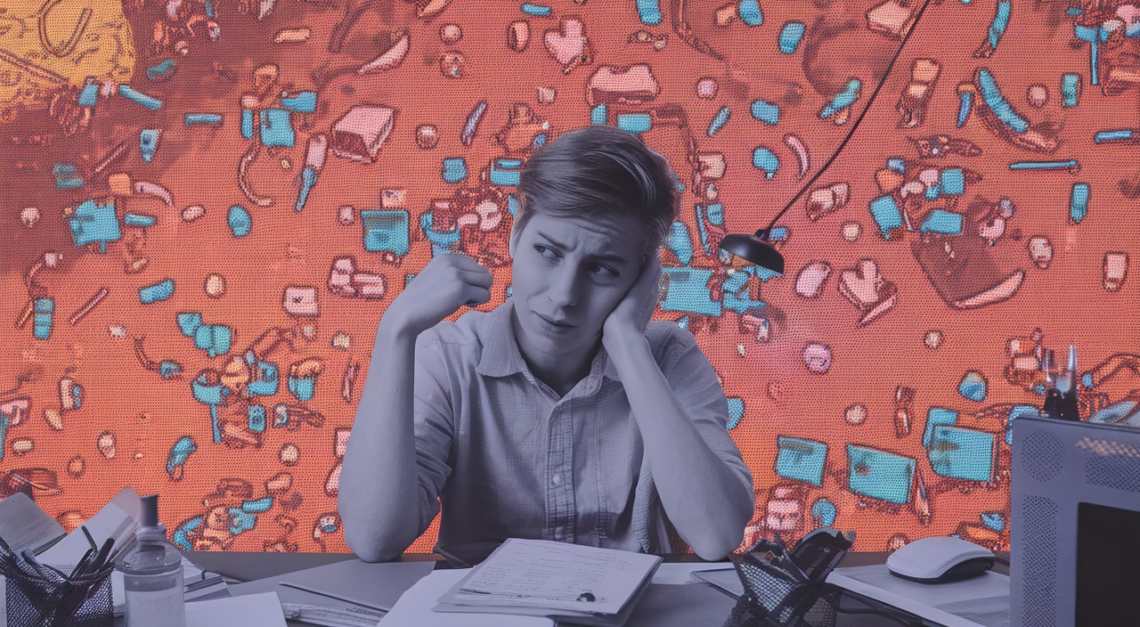
Why Embracing Chaos and Overthinking Actually Helps You Feel More in Control
Because pretending everything’s fine when your anxiety is screaming louder than a fire alarm in a therapy office just doesn’t work. When you’re dealing with high-functioning anxiety, embracing your internal chaos and overthinking tendencies with honest humor—especially the dark kind—flips the script from ‘What’s wrong with me?’ to ‘Oh cool, my brain’s just throwing a rave right now.’
TL;DR
- Anxiety and burnout don’t magically go away with positive affirmations. Embracing chaos and overthinking acknowledges reality instead of faking peace.
- Dark humor is a survival strategy. It’s how many high-functioning anxious creatives process overwhelm without combusting.
- Self-awareness beats suppression every time. You can’t outrun your brain, so you might as well analyze its absurdity with a laugh.
- Overthinkers aren’t broken. Many just need tools tailored to our emotional chaos—not one-size-fits-all mindfulness apps.
- Real healing starts with radical honesty. Even if that honesty sounds like, ‘I cried in the bathroom and then made a meme about it.’
Embracing the Chaos: A Darkly Funny Approach to Anxiety and Overthinking
Finding Humor in Overthinking and Anxiety

If overthinking were a sport, many of us would be Olympic-level gold medalists with anxiety-induced heart palpitations as our personal trainers. Our minds interpret a mildly delayed text as a friendship-ending disaster. Replaying that awkward thing we said in 2017? Built into our daily meditative routine. Sound familiar?
Here’s the kicker: once you realize how absurd your intrusive thoughts are, coping with anxiety and burnout becomes a lot easier—or at least laugh-worthy. You start to see the sitcom of it all. Not in a ‘Haha I’m fine’ kind of way. In a ‘My brain decided to catastrophize grocery shopping, and honestly it deserves an Emmy’ kind of way.
This is where dark humor slips in as your coping strategy. It’s not about minimizing your struggle—it’s about reframing it. Laughing inappropriately in the face of breakdowns isn’t dysfunction. It’s adaptation. It’s turning, ‘I’m spiraling’ into ‘I’m spiraling, but I brought snacks.’
Coping with Burnout: Dark Humor as a Survival Tool
Let me paint the picture of high-functioning anxiety: You’ve accomplished more this week than most people do in a month, and yet you lie in bed whispering, ‘I should have done more.’ Classic burnout disguised as productivity. We push until we break, then joke about the breaking as a way to avoid feeling how deeply undone we really are.
When you’re navigating burnout, it often doesn’t look like collapsing. Sometimes it looks like achieving. Performing. Smiling while a small part of your soul quietly flakes off in the corner. So, what’s the antidote? Honest-to-God acknowledgment—with levity. Sarcasm becomes a shield not to hide the pain, but to mock the system that convinced us our worth is tied to productivity.
When you use dark humor as a coping mechanism, you give language to the unspeakable. It’s the joke that says, ‘I’m barely holding it together,’ but actually means, ‘I see myself, and I’m not letting the chaos win.’
Overcoming Overthinking through Self-Reflection
Self-reflection and overthinking walk a fine line when you’re dealing with high-functioning anxiety. One leads to insights; the other to imaginary scenarios where your dentist hates you for flossing wrong. The difference? Intention.
Overcoming internal chaos isn’t about shutting up your thoughts—it’s about inviting them in for coffee and saying, ‘Explain yourself.’ It’s converting overthinking into journaling. Late-night spirals into pattern recognition. It’s choosing to look at your triggers and ask, ‘Is this anxiety or am I just dehydrated again?’
That kind of self-reflection, driven by curiosity instead of criticism, helps you make peace with the noise. You start knowing your inner chaos like an old coworker. Still annoying, but predictable. Manageable through coping with anxiety strategies that actually work.
Embracing Messy Emotions with a Darkly Funny Spin
Here’s the unpopular truth about embracing chaos: messy emotions aren’t flaws to clean up. They’re signals. Useful, wild, screaming signals. And much like your ex-texting-at-2AM impulses, they shouldn’t be ignored when you’re coping with anxiety and burnout. They need to be heard, understood… and if possible, made into memes.
We’re raised to fear the mess—especially those of us toggling anxiety, burnout, and performance culture like a bad Netflix interface. But mess doesn’t mean failure. It means feeling. To navigate it, try this: next time you feel like a walking trash fire, don’t fight it. Say, ‘At least I’m the warmest person in this room.’
Dark humor gives us space to be both broken and surviving when dealing with high-functioning anxiety. It quiets the shame voice by giving it a mic and saying, ‘Roast me.’ And somehow, that’s where healing often begins.
Final Thoughts: Your Chaos Might Be Your Superpower
If your mind feels like 43 tabs open and one’s playing music you can’t find, congrats—you’re one of us. But you’re also human, and more than worth knowing. When you’re embracing chaos and overthinking with gentle curiosity (and the occasional deadpan joke), you can find self-compassion. And self-compassion? It’s the opposite of burnout. It’s the whisper that says, ‘You’re allowed to be a mess. Just don’t forget to laugh.’ That’s how you truly start coping with anxiety and burnout on your own terms.
FAQ
Is overthinking always a bad thing?
Not necessarily. Overthinking can become useful if you redirect it toward constructive reflection rather than panic spirals. It’s about taming it without amputating it.
How can dark humor help with anxiety?
Dark humor can relieve emotional pressure by making space for uncomfortable thoughts without judgment. It’s similar to gallows humor among surgeons or emergency responders—humor as oxygen when emotions become suffocating.
What are quick coping strategies for high-functioning burnout?
Try naming your burnout out loud, writing one brutally honest diary entry, taking a real break (not scrolling in bed), and watching a dark comedy that gets it. Also, pizza. Always pizza.
Can embracing chaos improve mental health?
Surprisingly, yes. Acceptance over suppression leads to self-awareness, which is a key ingredient in emotional regulation. You can’t fix what you’re pretending doesn’t exist.
What do I do when the jokes stop working?
That’s your cue to get support—from a real human, not just memes. Jokes can hold you up, but they can’t carry you forever. Therapy, rest, medication… all valid tools. Dark humor works best when it’s not your only coping strategy.
How do I tell the difference between chaos and burnout?
Burnout often masquerades as chaos but comes with deep fatigue, emotional numbness, and apathy. Chaos has energy. Burnout feels like waking up underwater.
Why do I feel guilty resting?
Because we live in a culture that spoon-feeds us the lie that rest equals laziness. Undoing that takes time and practice. Guilt isn’t a compass—it’s often just programming.