How do you know you’re actually burnt-out and not just ‘lazy’?
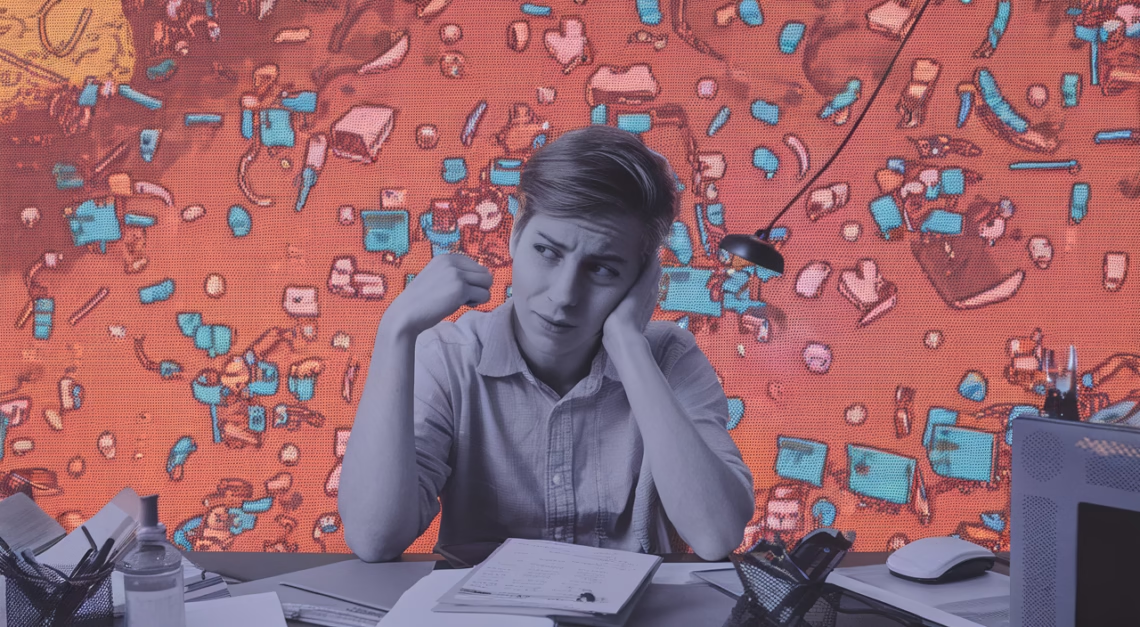
Here’s the thing: creative burnout doesn’t come with a neon sign screaming, “Hey you! It’s burnout, not lack of talent!” No, that would be too easy. Instead, it shows up in quiet, insidious ways — like when you open Photoshop and cry into your coffee for the sixth day in a row, or when the thought of checking your email gives you hives. If you’re constantly battling exhaustion, self-loathing, and the growing suspicion that your cat is judging your lack of productivity, congratulations — you might be experiencing actual emotional exhaustion, not just a case of the procrastinatory blahs.
TL;DR: Surviving Creative Burnout Without Setting Everything on Fire
- Creative burnout isn’t failure — it’s an overextended mind waving a white flag.
- Emotional exhaustion often masquerades as laziness.
- Self-doubt is not a personality trait — it’s an infection. There are ways to disinfect.
- Overcoming perfectionism is about learning to love your weird, flawed drafts.
- Burnt-out artists aren’t broken — we’re just crispy.
- Even in the trenches of burnout, inspiration is lurking — often disguised as crap TV or dreams about anthropomorphic pizza.
Learning How to Cope with Creative Burnout: Embracing Your Beautiful Mess
The phrase “creative burnout” sounds like a TED Talk waiting to happen — slick, hashtagged, and ultimately useless unless you’ve lived it. But if you’re reading this in sweatpants, staring blankly at unfinished projects and wondering whether that empty feeling is inspiration dying or just your soul evacuating… yeah, you get it.
The real enemy of the overwhelmed artist isn’t a lack of ideas — it’s the myth of the flawless masterpiece. We’ve internalized that if our work isn’t profound, boundary-breaking, and viral on day one… then we’ve failed. Newsflash: perfectionism is not ambition in disguise; it’s a creativity assassin that thrives on your emotional exhaustion.
Tip: Start by creating something terrible on purpose. Doodle something ugly. Write fanfiction where every sentence ends with “and then everything exploded.” When you’re learning how to cope with creative burnout, imperfection becomes your playground, not your enemy.
Recognizing the Signs of Emotional Exhaustion in Artists
Here’s what often happens before the burnout sirens hit: you stay up all night in ‘flow state’ (aka manic spiral mode), produce nothing you’re proud of, then crash for days, blaming yourself for the lack of follow-through. Sound familiar?
Signs of emotional exhaustion in overwhelmed artists look like:
- Your once-beloved projects feel repulsive
- Your brain runs on caffeine and self-loathing
- You’re a human error message — all blinking cursor, no output
- The idea of “hobbies” makes you laugh and cry
If you check three or more, your creative drive hasn’t died — it’s just asking for a damn nap. Creative burnout doesn’t always mean quitting. Sometimes it means silence, softness, and space to breathe before bringing the spark back.

Overcoming Self-Doubt: A Survival Guide for Struggling Artists
Let’s talk about the internal heckling gremlin — that voice that turns every creative attempt into a referendum on your worth. “This sucks,” it says. “You suck,” it adds, just to clarify.
This self-doubt feels terminal when you’re in the thick of creative burnout. But here’s the nasty truth: it’s boring. No, really. Every struggling artist battles this inner monologue, and it repeats itself like a broken record. Your doubt isn’t original — it’s a tired rerun. Tell it to reroute.
How to cope with creative burnout and silence this gremlin:
- Write your fears down. They look smaller on paper.
- Talk to one (just one) trusted creative friend. Share your chaos.
- Make a list of every weird little thing you’ve ever made that surprised you.
Art doesn’t spring from certainty — it crawls out of confusion, coated in glitter glue and panic. You’re right on schedule.
Finding Inspiration When You’re Emotionally Drained
Finding inspiration when you’re experiencing creative burnout is like asking a raccoon to recite poetry — theoretically possible, but entirely unreasonable. Still, it happens. Not usually when you stare hard into a blank page, but when you least expect it.
I once wrote an entire short story in the middle of a depressive hole after watching a goat faint on YouTube. What I’m saying is: inspiration does not come gift-wrapped from the muse. It shows up while you’re doom-scrolling, crying in Target, or walking your grief-ridden dog past a puddle that looks vaguely like Virginia Woolf.
If your brain is too crispy to create, consume slowly and strangely. Watch documentaries about ancient trees. Read memes. Listen to that one haunting song on repeat until you cry for reasons you don’t understand. Give your brain trash food until it’s ready for vegetables again. This is how overwhelmed artists often rediscover their spark — through the side door, not the front entrance.
Overcoming Perfectionism: Your Creative Recovery Toolkit
If you’re wondering why your latest project is still unfinished and you’ve rewritten the same sentence 47 times — hi, it’s your old friend, perfectionism. That manicured little tyrant with the perfect bullet journal and zero chill.
Overcoming perfectionism doesn’t just speed you up — it convinces you the work is worth doing even when it’s not divine. Perfectionism whispers, “You should just wait until you’re better.” Better never comes. The only way past this is through a revolt of messy, flawed honesty.
Try this approach to overcoming perfectionism in your art:
- Set a 10-minute timer and make the worst version of your idea possible.
- Share something unfinished with someone who won’t critique.
- Post something with typos. Watch the world not end.
Overcoming perfectionism isn’t instant. But every time you create despite the urge to polish it to death, you’re winning the battle against creative burnout.
Final Thoughts: You’re Burnt, Not Broken
If you’ve made it this far and are still doubting whether you’re a “real” artist because you’ve been emotionally exhausted lately — take a deep breath. You’re not broken. You’re not lazy. You’re exhausted from trying to birth beauty in a world on fire. That takes a toll.
Creative burnout isn’t the end — it’s a scream your body makes when you’ve ignored the signs too long. Now it’s time to be gentler. Take naps. Walk slowly. Laugh at the absurdity of your own drama. And when you’re ready, return to your work — imperfectly, shakily, hilariously messed up. Just like the rest of us overwhelmed artists learning how to cope with creative burnout one terrible first draft at a time.
FAQ
- Is creative burnout normal?
Yes — it’s increasingly common among artists, writers, designers, and digital creatives. It’s a sign to slow down, not give up. - How long does creative burnout last?
There’s no exact time frame. It depends on your environment, rest, and mental health support. It could last weeks or months — recovery is a process. - What are healthy ways to reset creatively?
Try play-without-output: journaling, unstructured doodles, analog crafts. Lower the stakes and avoid comparison. - Should I take a break from creating?
Yes, if your creativity feels more like punishment than joy. Breaks replenish your mental compost. Take them. - How do I deal with imposter syndrome during burnout?
Imposter syndrome thrives in isolation. Share your feelings with other creators — chances are they’re feeling the same. - Is perfectionism ever useful?
Only when it’s tamed. Aim for excellence, not flawlessness — there’s a difference. Beauty lives in the mistakes. - Can I create while still burned out?
You can, but only gently. Make space for play and imperfection. Ruthless productivity is not the goal — connection is.