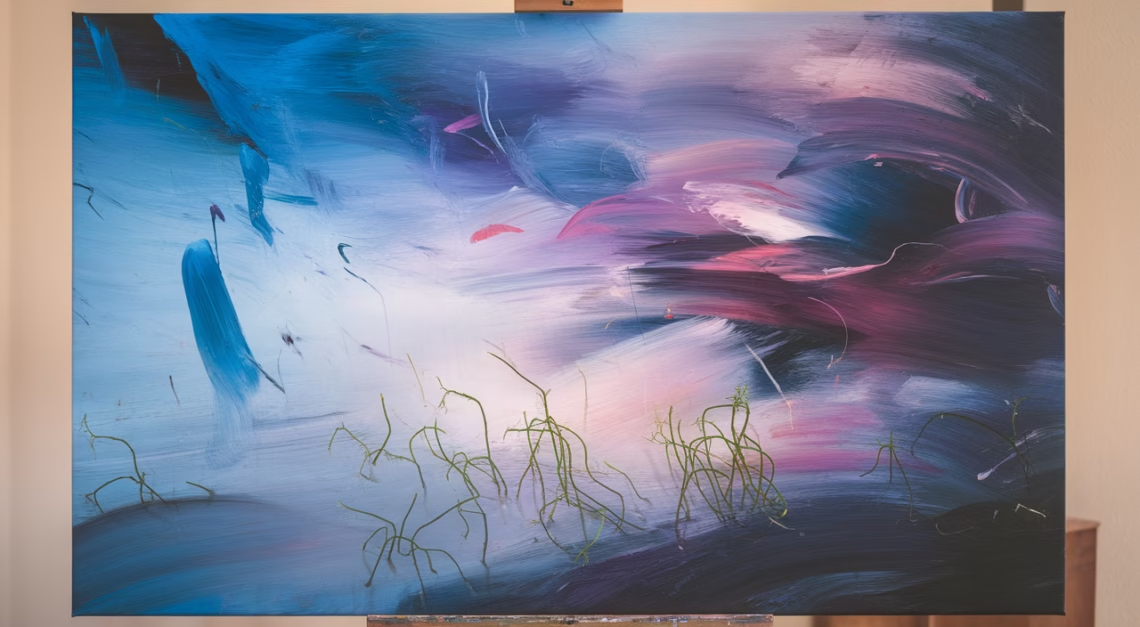
Why do I feel everything and nothing at once?
It’s the emotional equivalent of pressing every piano key simultaneously—except the piano is your brain, and the melody is anxiety with a backing vocal of burnout. You’re overwhelmed. Then numb. Then crying over a crooked shelf. Sound familiar? This paradox is your psyche’s unhelpful way of waving a white flag. Let’s decode it—without pretending kale smoothies are salvation.
TL;DR:
- Dealing with anxiety and burnout often coexist, especially in creatives with emotional depth and performance pressure.
- Feeling “everything and nothing” can be a defense mechanism of a brain stuck in survival mode.
- Strategies that work: Setting useless perfectionism ablaze, scheduling self-destructive thoughts like dentist appointments, and laughing through the existential dread.
- This article serves: The real ones—burned-out millennials needing mental health tips for creatives beyond “meditate more.”
The Struggle is Real: Coping with Creative Burnout

Welcome to Your Personal Apocalypse (aka Tuesday)
If you’re dealing with anxiety and burnout as a creative, chances are you’ve sat in front of a blinking cursor longer than you’ve ever sat with your feelings. Creative burnout isn’t just being tired—it’s being emotionally pickled in cortisol with a side of imposter syndrome. You’re not lazy. You’re drowning in invisible obligations while trying to make something meaningful with a brain that’s spinning like a dying hard drive.
So let’s talk creative burnout coping mechanisms that don’t involve running away to the woods (unless they have solid Wi-Fi). Here’s what’s helped me and other creatively fried minds scrape off the productivity plaque:
- Do “bad work” on purpose: Perfectionism is a liar wearing a supportive sports bra. Write badly. Paint sloppily. Forward that email without rereading it 68 times.
- Schedule guilt-free nothing time: Sit and stare at a wall. Seriously. Don’t pack every hour with ‘fixing yourself.’
- Inventory your creative output: Not for judgment—just to prove you’ve actually done more than you think.
Because burnout isn’t cured with bubble baths when the house is on fire. These strategies for managing overthinking and creative overwhelm help you douse small flames where you can and know when to walk out the metaphorical front door holding just your laptop and last shred of hope.
Overthinking and Overworking: Finding Balance in a Stressful Work Environment
Why Your Brain Needs a Pop-Up Blocker
Your job says “deadline,” your brain says “deathline.” Welcome to mental health struggles at work, where every Slack ping carries the weight of existential dread. The cubicle (or bed-desk hybrid) has become a minefield of overthinking. Did I sound bored in that email? Is Karen mad? Was that semicolon pretentious?
If your inner monologue moonlights as a conspiracy theorist, here are some proven strategies for managing overthinking without adopting stoicism as a religion:
- Schedule your spirals: Give yourself 10 minutes at 3 PM to catastrophize. Then move on. (Yes, actually set a timer.)
- Rename your inner critic: Mine is called “Debbie.” She’s spicy and dramatic but usually wrong. Give yours a name so you can roll your eyes when they act up.
- Use the 5-5-5 Rule: Will this matter in 5 minutes? 5 days? 5 years? If not, park it.
Your brain is just trying to protect you—but sometimes it overfunctions like a dog barking at its own reflection. You’re not broken. You’re just chronically online and under-rested. These mental health tips for creatives acknowledge that dealing with anxiety and burnout requires practical tools, not platitudes.
Embracing Imperfection: Tips for Managing Anxiety in a Perfectionist World
Burn the Pinterest Vision Board
If you’re anxiety-prone and artsy, perfectionism is the paper-mache straightjacket keeping you “safe.” Society tells you you’re not enough, so you spend your existence trying to become enough while erasing your own humanity along the way.
Here’s the uncomfortable truth: embracing imperfection in a perfectionist world is rebellion. Here’s how to start dealing with anxiety and burnout by loosening perfectionism’s grip:
- Post the ugly draft: Imperfect action beats flawless overthinking every time.
- Stop productivity-masking: You color-coded the to-do list again instead of starting the damn project. We see you.
- Measure progress by feel, not finish: Maybe the win today is putting on pants. Pants exist. You exist. You win.
Self-compassion isn’t coddling—it’s survival. Start talking to yourself like someone who deserves kindness, not click-bait self-help. These creative burnout coping mechanisms work because they meet you where you are, not where Instagram thinks you should be.
Finding Hope in Dark Times Without Burning Sage
Because the Light at the End of the Tunnel Could Just Be Fluorescent Trauma
Look, I’ve had days where “hope” was just code for “maybe I won’t quit everything and join a commune today.” But some of the best mental health tips for creatives are painfully non-aesthetic:
- Make plans two weeks out: Not because you’ll feel better—because it gives your brain a breadcrumb trail back to life.
- Adopt “good-enough living”: You ate food today. It didn’t involve tears or shredded receipts. That’s adulting, baby.
- Practice defiant joy: Put on weird music. Dance badly. Watch YouTube videos of goats in pajamas. It’s spiritual CPR.
This isn’t about pretending everything is okay. It’s about noticing—just noticing—that sometimes, there’s a sliver of okay wedged between all your chaos. Finding hope in dark times isn’t toxic positivity. It’s showing up anyway—even if slightly unhinged—and recognizing that dealing with anxiety and burnout is a practice, not a destination.
Final Thoughts: You Are Not a Lost Cause (You’re Just Tired)
So here’s the deal. You’re not weak. You’re a deep-feelings creative in a world that commodifies output and vilifies rest. That’s not a you-thing. That’s a society-has-poisoned-the-pool thing. Your anxiety and burnout aren’t personal failures—they’re signs that your system is begging for kindness, slowness, and maybe a therapist who gets memes.
Dealing with anxiety and burnout doesn’t mean being “better.” It means being truer. So go ahead—laugh at the absurdity. Cry when your coffee tastes weird. Breathe, slowly. And know there’s nothing wrong with you, other than living in Late Stage Capitalism with too many feelings and not enough nap time.
Frequently Asked Questions
- What are real signs of creative burnout?
Chronic exhaustion, loss of creative joy, procrastination masked as perfectionism, intense self-doubt, and existential dread triggered by font choice. - How can I manage overthinking without therapy?
While therapy helps immensely, try journaling intrusive thoughts, scheduling spiral time, using mental reframing techniques, and avoiding 3-second doomscrolling breaks. - Are there mental health tips for creatives that go beyond mindfulness apps?
Yes! Try body doubling with other creatives, turning off quantifiable goals for a bit, creating just for play, and finding community in shared “WTF is this life?” moments. - Is burnout fixable or permanent?
Burnout is reversible, but requires actual recovery—not just a weekend off. Long-term healing means boundaries, recalibration, and radical honesty about capacity. - How do I ask for help without sounding weak?
Flip the narrative: Asking for help is strength in neon. Phrase it honestly (e.g., “I’m overwhelmed—I need support”) and remember vulnerability often earns respect, not shame. - What if I never feel motivated again?
You will—but maybe not in the same way. The goal isn’t to hustle again. It’s to rewire your motivators for fulfillment over fear.